

 MAS Seeds Global
  Austria
  Belgium
  Bulgaria
  Denmark
  France
  Germany
  Italy
Italy  Netherlands
  Poland
  Portugal
  Romania
  Russia
  Serbia
  Spain
Spain  Turkey
  United Kingdom
  Ukraine
  China
China  Mexico
  Morocco
  West Africa
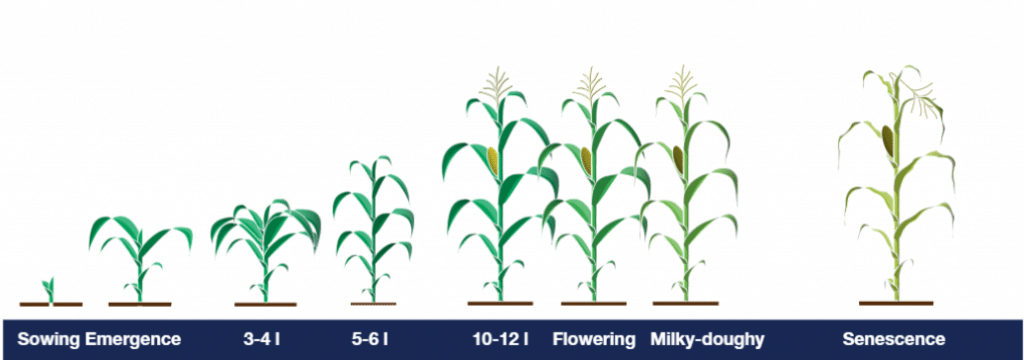
Key Growth Stages of Maize

Knowing the growth stages of maize is crucial for farmers seeking to enhance crop yields and sustainability. Maize crops require careful management from germination to maturity. Familiarity with these growth phases allows farmers to make informed decisions about irrigation and fertilisation timing, in order to optimise the use of resources and minimise their environmental impact. In essence, understanding the growth stages of maize is a practical tool farmers can use to maximise productivity, ensure yield security and adapt to changing climate conditions.
The eight key growth stages of maize for crop management:
More about maize


1. Emergence
- Maize requires a soil temperature of 10°C for germination
- Seeds need to be surrounded by sufficiently fine and moist soil
- An average of 12 to 17 days is required to reach emergence, depending on the temperature of the soil

2. Weaning: four-leaf to five-leaf stage
- Appearance of new roots (crown roots)
- The plant is no longer dependent of the seed’s reserves – it is weaned
- Sensitivity to nutrient deficiencies, phosphorous in particular
- Final plant density determined

3. Appearance of ears: eight-leaf to ten-leaf stage
- Appearance the ears (number of rows)
- At ten leaves, we reach the elongation stage. Need for lots of water and nutrients
- Plant is sensitive to cold temperatures (<8°C), low sunlight and the application of herbicides

4. Tassel visible
- Plant stage that determines the number of ears per plant
- The number of ovules is 90% established
- There is a great deal of sensitivity to lack of water and nitrogen at this growth stage

5. Female flowering
- Fertilisation of ovules by pollen
- High sensitivity to water shortages:
- If under water stress, grain development can be disrupted
- High temperatures can cause bristles not to exit
- Fertilisation problems can cause disturbed grain development

6. Grain abortion limit
- Beyond this stage, grain abortions are no longer possible
- Happens at three weeks after fertilisation, i.e. 250 days after flowering
- Final number of grains
- This stage marks the end of maximum sensitivity to water stress

7. Doughy grain stage
- 50% moisture stage
- Last irrigation stage = 32% whole plant DM stage

8. Black layer
- Grain physiological maturity – end of grain fill
- Grain moisture at 32%
- Formation of black layer: closing of vessels between grains and cob

Find a product
Discover a full range of maize products for any use (grain, silage or biogas), for organic agriculture and for temperate or tropical regions.

Contact us
Our local teams visit farms and distributors on-site to give you the best advice for your location. Find your local MAS Seeds® consultant by visiting a country website or fill out our contact form here.
Discover other crop advices

Maximising maize yields starts with effective sowing strategies. Proper planting determines about 50% of your yield potential. In this guide, you’ll find practical steps to …

Potassium and phosphorus are the key nutrients to consider in your lucerne fields fertilisation plan. Fertiliser should be applied as alfalfa starts to regrow. Management tips for …

Dodder has been impacting lucerne production since the 1950s. Prevention begins with certified seeds as the only way to eradicate it is by destroying the host plant. Tips for …